

Palantir made 420 chore coats and they sold out in five hours. At $239, the ten-ounce American bull denim, French silhouette, sewn in Montana coats feel too close to clothing to just be called ‘merch’.
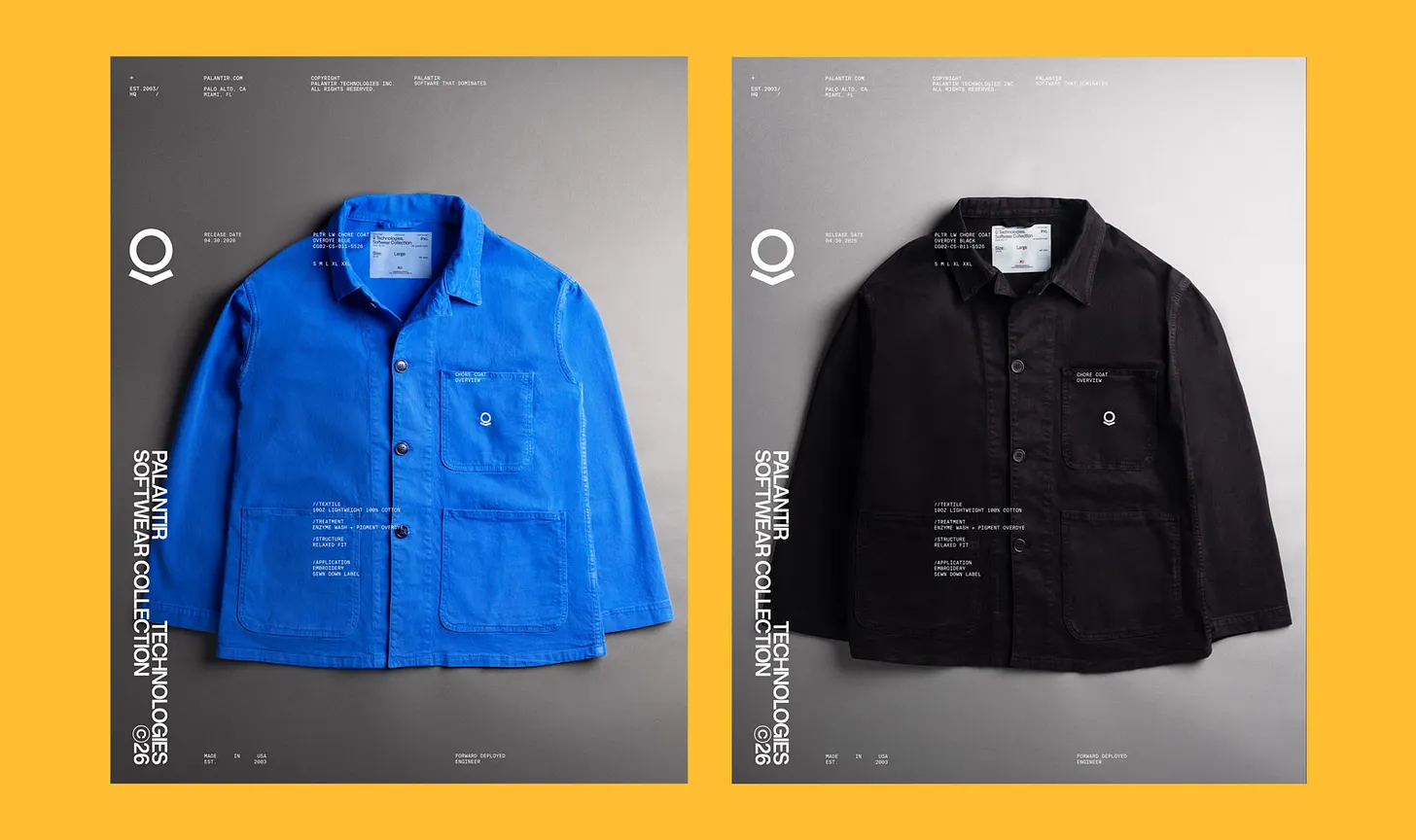
Eliano Younes, who runs strategic engagement at the company, called it “great for activities.” The word ‘activities’ does lots of heavy lifting for Palantir. Activities is a euphemism deployed when the unspeakable specifics of the company’s business — ICE targeting, kill lists, NHS data contracts — could spoil the cut of the jacket.
The chore coat is a citation for fashion historiography. Military influences are a backbone of fashion design at large, and workwear in particular has been about the slipstream between labor and the bourgeoisie.
The bleu de travail, designed in nineteenth-century France to hide oil and indigo on the bodies of laborers, has spent the last century climbing up the social ladder.
For contemporary wearers, this garment demarcates the act of labor as the kind that leaves a mark: Carhartt detail jackets on graphic designers, Dickies double-knees on photographers. Utilitarian for sure, but also dis-intermediated as creative professions become increasingly distanced from the hand-made and the manual.
Palantir’s drop inverts the meaning without breaking the silhouette, but it makes a small slip in the process. Derek Guy, the menswear historian who lives on the timeline as @dieworkwear, pointed out within hours that Palantir’s “American” coat is patterned after Vetra and Le Labourer — French workwear, three pockets, not the four-pocket denim-or-duck-canvas Sears/Lee/Carhartt blueprint a US-patriotic company would have copied.
But that makes sense, because Palantir clothing dresses the metabolised version: not the worker, but the figure who controls the worker.
What it brings to the wearer is the image that Peter Zottolo, the photographer-electrician quoted in the New York Times alludes to: “When you wear workwear, you’re telling people, ‘I’m down to earth.’ It usually is a disarming outfit.”
What does it mean for a defense contractor to adopt the visual register of your local handyman? This is what Kyle Chayka has been calling tastewashing: tasteful styles and symbols deployed to lend an aura of quality to products whose mechanisms and values are abstract and incomprehensible; and it’s what we named the Glitchcourse: a condition where the glitch is no longer the exception but the operating logic of public discourse itself. Tastewashing for CorpMerch normalizes through wearability.
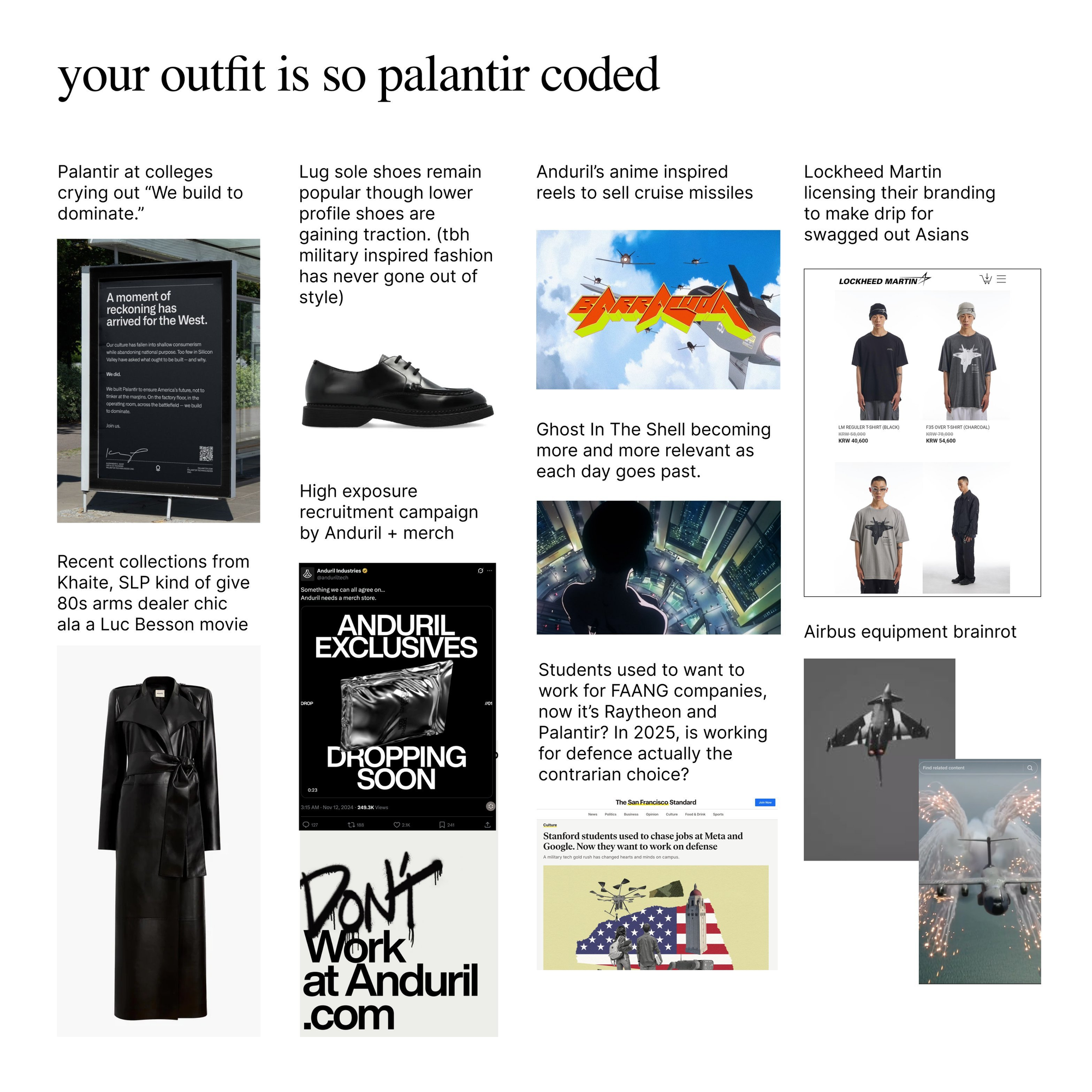
And arguably - isn’t Palantir just closing the slippage on the historical precedence of US Military wear entering the world of collection, replicas, vintage resellers, and informing technical design? What is the difference between a vintage bomber jacket, camo trousers, and a Palantir chore coat, really?
The coding of military is everywhere already: as SUVs become the most popular car, so do the colorways of sand and stone that take inspiration from tanks. In fashion, beyond the classic silhouettes of trench coats (and many other mainstays), tactical and tech-led civilian wear has been leaning toward military-issue for decades. Pitti Uomo’s Fall-Winter 2026 floor was full of M-65 silhouettes — with jackets was available in perfect reproduction from specialists like The Real McCoy in Japan or in replica cuts from downstream Taobao stores in China.
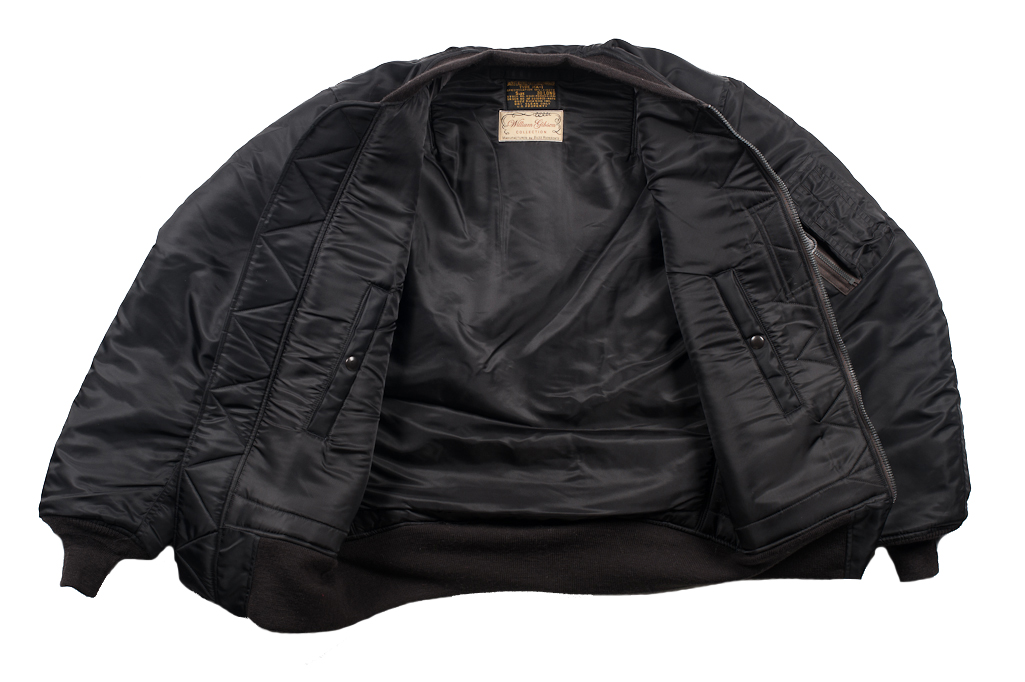
Perhaps though, the merch is not the point. The CorpMerch is the least committal expression of a much wider cultural campaign whose grammar Simon Denny articulated clearly in the May edition of Artforum and who so succinctly pulls together threads we’ve also been tracking: the increased militarization of everyday life.
Denny observes how Defense tech is reaching, with disconcerting precision, into the iconographic toolbox of Italian Futurism. Marc Andreessen’s 2023 Techno-Optimist Manifesto quotes Marinetti by name. Palantir’s AIPCon7 staged itself as the “Palantir Museum of Art” with mock-MoMA branding and the tagline THERE IS ONLY THE ARTIST AND THE WORK projected over Karp’s head. Anduril’s promotional imagery for its Roadrunner and Barracuda drones is a direct descendant of Tullio Crali’s Aeropittura — vertiginous cockpit perspectives, luminous gradients, the cruise missile rendered as sublime. The company’s recruitment poster The Grind That’ll Win is a near-identical 2024 re-issue of the 1942 War Production Board original of the same title. The ideological and art historical lineage is clearly articulated.
As Denny outlines, the contradiction is most cleanly embodied in Alex Karp himself. Palantir’s CEO took his PhD in social theory at Goethe University Frankfurt, supervised by academics in the direct lineage of the post-Marxist Frankfurt School — Habermas, Adorno, the German tradition whose intellectual ground is the critique of the aestheticization of politics and culminates in the ending of Walter Benjamin’s 1936 essay 'The Work of Art in the Age of Mechanical Reproduction' that issues a warning on the exploitation of aura.
In the closing chapter of Karp's 2025 book 'The Technological Republic' is titled, with no detectable irony, “An Aesthetic Point of View.” In it he re-enlists aesthetic judgment as a means of distinguishing national seriousness from consumer drift.

Futurism in 1909 needed manifestos, magazines, and a sympathetic dictatorship. Futurism in 2026 runs on VC media properties, Substack ideologies, and a Shopify site. In the defense-tech aesthetic complex, the avant-garde and the state are collapsed into a merch drop: the shirt is the manifesto, the hat is the recruiting poster.
Contemporary defense tech player Anduril, like Palantir another company whose name is based on Lord of the Rings mythology (in Tolkien terms, it could translate as ‘flame of the West’) base their Andurilgear.com “Relics” line on in rarity tiers (Common, Rare, Legendary) - bringing the mechanics of trading cards and table-top games to the world of missiles.
Defense tech is not the only ideological category moving into CorpMerch. Crypto brands are also styling uniforms for their communities who envisage redefinitions of what ‘work and money’ might mean through referential fashion.
Robinhood’s online store sells a “Stealth Bomber Jacket” ($740) next to a “Liquid Asset” water bottle and a $3,000 “Waka Waka Chair.” Coinbase has been moving “Diamond Hands Balm,” “Trading Candles,” a “Genesis Block T” - devotional consumer goods for the financial faithful.
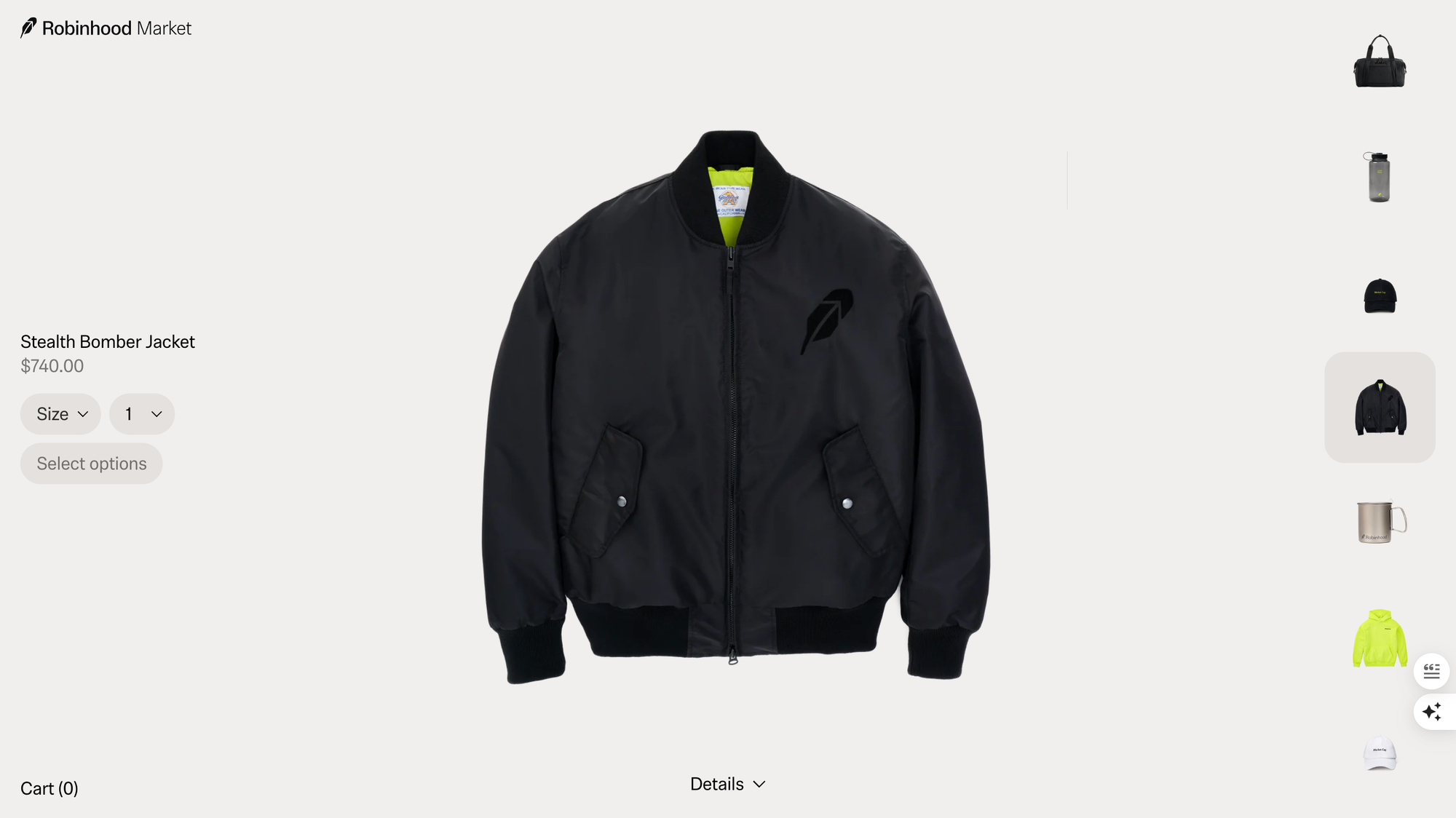
And so it follows that the other category players who have a stake in the definition of ‘work’ and labor are deploying CorpMerch. We’ve already seen the co-opting of analog aesthetics play out in the first tranche of AI brand campaigns last year, alongside a fascination for appropriating media formats of the past as the distinctive brand assets of LLM models.
As Anthropic does Claude pop-ups at craft coffee shops, the new tech bourgeoisie has kitted itself out as a corporate class with a workwear wardrobe.

The 1930s mechanism Benjamin observed was symbolized through monumentality and parades. The 2026 version comes to life via gamified streetwear mechanics. With CorpMerch, aesthetic and financial flows neatly combine.
Chloe Iris Kennedy’s line on the Lockheed Martin streetwear drop says it all: “In the early 2000s camo print was strategically placed in the fashion zeitgeist as a means of aligning the western world with the war on terror. Nowadays war machines can simply release merchandise, label it gorpcore, and the public will willingly fund their acts of terror.”
Younes said the Palantir coat is “not political. It’s about people who love Palantir and are aligned with our mission.” That's a heady mix of corporate jargon, military speak, and patriotic metaphor.
Palantir’s own product hides ‘custom quotes sewn label inside’ as a way of proudly wearing that ideological alignment on the inside, while slipping into casual workwear on the inside. Palantir sold out all 420 coats in five hours.
References:
- Simon Denny, “Epic Fury: The Dark Art of Defense Tech,” Artforum, May 2026
- Yola Mzizi, “Palantir Is Making a French Chore Coat,” New York Times, April 30, 2026
- Kyle Chayka, “The problem of Palantir’s chore coat,” One Thing, April 24, 2026
- Dazed, “Techno-fascist fashion: Why Silicon Valley is moving into menswear”
- Anduril Gear shop, “Rebuild the Arsenal” line + Anduril Relics
- Robinhood Market shop, Stealth Bomber Jacket — Robinhood Shop
- Coinbase Shop, Diamond Hands Balm / Trading Candles — Coinbase Shop
- Palantir Store, “Lightweight Chore Coat Blue” product page — Palantir Store