

If you’ve spent enough time on the internet, you’ve probably come across endless discourse about “taste,” “taste‑washing,” and “taste slop.”
taste is a new core skill
— Greg Brockman (@gdb) February 16, 2026
How do we define taste in the age of machine intelligence, when most of what we see is already shaped by algorithms and what Emily Segal calls “tasteslop”, slop made out of things considered tasteful, tasteful things deployed in service of slop, and an incessant tech discourse trying to redeem all of it?
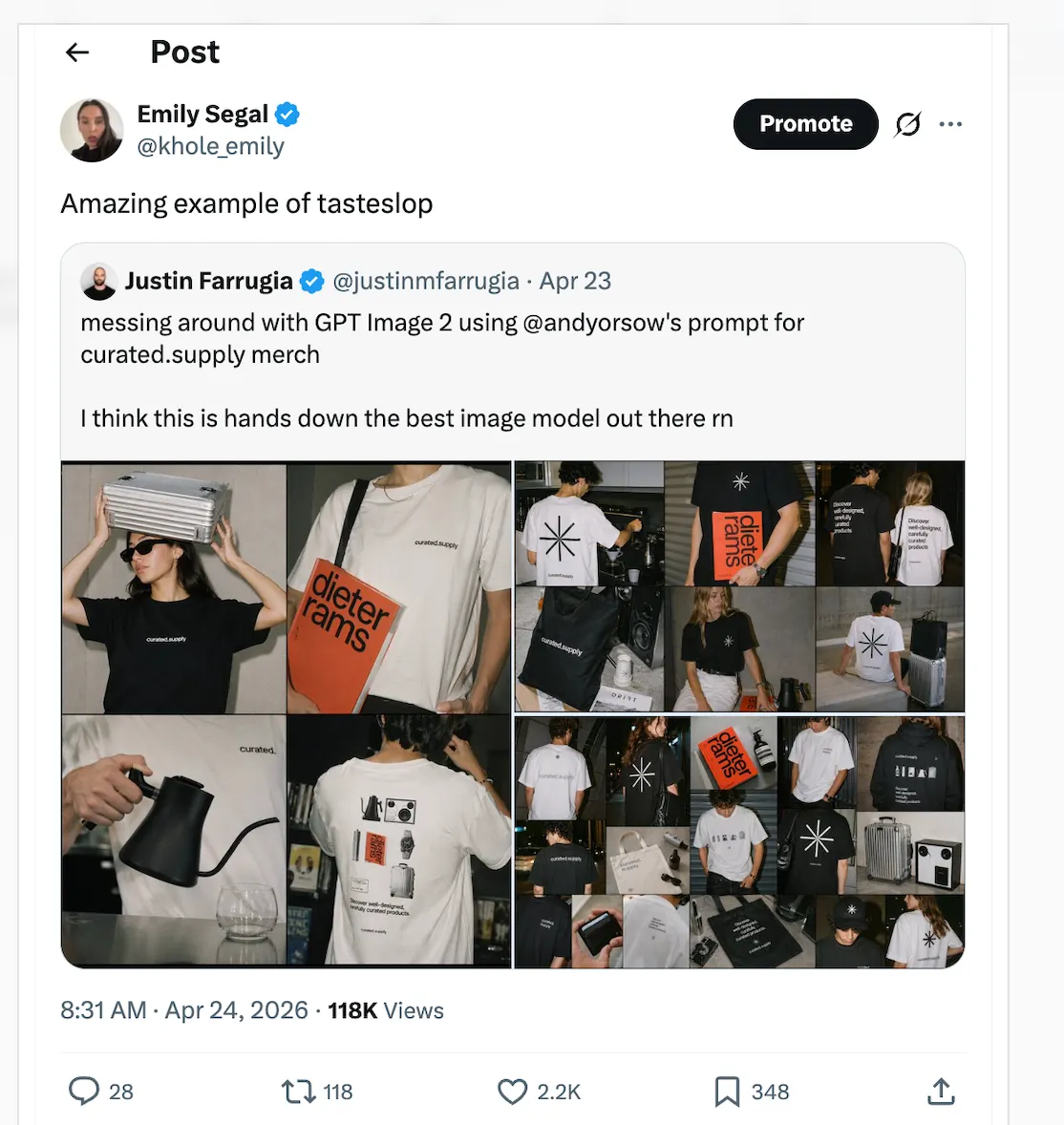
Does taste still set you apart, or does it mostly signal your ability to curate the right prefab references? Since the post-war consumerist era, calling someone “tasteful” implied a situated sensibility; now it also raises questions of class (who has the resources to develop that eye) and of economics: is taste primarily a profitable filter, a way to turn attention into status and status into deals? And can we still consider taste truly individualized when it can be fully automated or lab‑grown? As Ruby Justice Thelot has elegantly articulated across his Essays on Taste - we've returned to the historicity of taste as a negotiation between establishment and nouveau, gatekeepers and revolutionaries, the imposter and the impassioned.
A startup called Taste Labs with $18.5 million in seed funding. Their mission, in their words, is to “end AI slop” by building “the data and infrastructure layer to give AI models and agents taste.” Their founder says they want to measure, judge, and codify what “great” means in subjective domains, starting with design, so that AI can eventually tell you what’s good.
In light of all these conversations, whether in the studio, online, or in private, we thought it would be useful to share a mini syllabus: a list of sources, books, and media that have either shaped how we develop ideas or kept us orbiting these topics in their current shape.
Foundational Texts
David Hume: Of the Standard of Taste (1757)
Immanuel Kant: Critique of Judgement (1790)
Clement Greenberg: Avant Garde and Kitsch (1939)
Roland Barthes: Mythologies (1957)
Susan Sontag: Notes on Camp (1964)
Pierre Bourdieu: Distinction: A Social Critique of the Judgement of Taste (1979)
Hal Foster: The Anti-Aesthetic: Essays on Postmodern Culture (1983)
Current Links
Vogue Business — Amy Francombe: Good Taste in the Age of AI
In Praise of Gatekeeping — Taste 101
Gatekeeping as a function of taste. Why tech bros are obsessed with “taste”
Taste Test: Encrusting the Tortoise
Nemesis Global: Tasteslop
NM Content Today | Taste (2026)
Paul Graham: Taste for Makers (2002)
Class notes: JY and Alex
JY: Taste quickly veers into elitism; there's no exemplary "good taste" or purely "bad taste," only differing tastes. What I really object to is unconsidered taste, the innocuous kind that just harks back to whatever the algorithm conjures up and passes it off as discernment, or treats “good taste” as dogma: a fixed standard everyone is expected to accept without questioning.
What people call bad taste can actually be good taste, because it’s active, deliberate, and a little disruptive. Being tasteful sometimes means being a bit snarky. It means feeling fervent passion for the things you love and being willing to judge, out loud, the things you don’t. It means sitting across from someone who disagrees with you and resisting the urge to rush to the middle ground.
I appreciate it when people have quirky or even intentionally/ironically “bad” taste (acquired taste). But I cringe when people simply accept whatever culture throws at them, unthinkingly putting on clothing, shows, art, music, and objects just because they’re there, without paying attention to questions of taste at all.

Alex: Yes, absolutely. I come at this as someone who grew-up in a small rural village developing my own taste through making art, music, clothes, and being a voracious learner for things I was really into (and not) - and then studied 'taste' pretty formally through Philosophy, Discourse and 'the Academy' in my History of Art degree. For my MA, I focused on 'Modernism and its Subjectivities' and how the Avant-Garde and the Post-Modern operated to question the definition of 'taste' that you bring up.
I think that's really informed my own belief that any development of real taste in the contemporary sense has to mix 'high and low culture' in good measure.
Learn how the canon was created - who defined it, who they omitted, how and why it served them? But recognize adherence to that institutional form of taste and 'the academy' can be so constraining. Learn how taste is equally cultivated from obsessions, localities, and communities. I think there's real mastery of taste, in our work especially, when you're equally fluent in terrace culture style and terrazzo architecture.
Here's a great reminder from John Waters :)
xx,
Inner Chapter team