

When Pop Mart unveiled its latest character IP KeyA earlier this month, it was clearly pitched as the next step in the Labubu industrial complex: a sci-fi girl with razor-sharp bangs and matrix-ready styling, forever “generating herself” in an endless loop of self-becoming. Instead of instant hype like everyone expected, the launch detonated something else: weeks of accusations of plagiarism, nepo-baby discourse, and a broader crisis of faith around what Chinese youth actually want from IP in 2026.
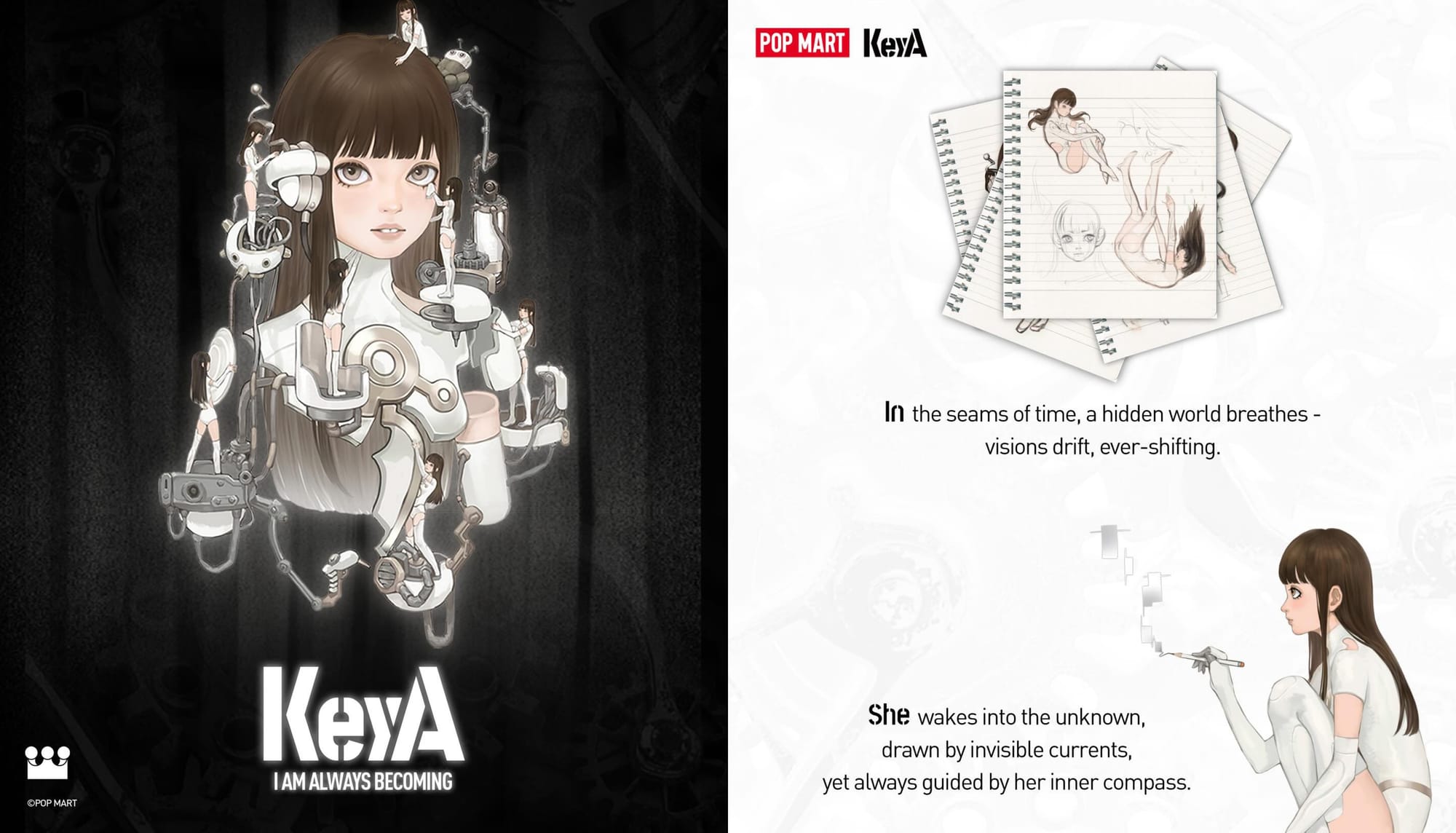
KeyA, created by illustrator/artist Yanran Chen, is meant to embody an always-in-progress self, a girl who refuses to be pinned down into a single personality or fixed narrative arc. In Pop Mart’s official language, she’s not lore-maxxing, she’s a sketch of a Gen Z subject in permanent beta, forever mid-render. Yet somehow, that ambiguity has not landed as liberating online, commenters are calling her a “Stranger’s OC (Original Character)”, a private character that somehow leaked into the mass market, and also asking why they are being asked to bankroll one artist’s self-insert into their desktop totem.
Fans quickly pulled up reference boards of Japanese illustrator Range Murata, noting how KeyA’s silhouette, outfit structure and soft sci-fi melancholy feel uncomfortably close to a whole lineage of light novel, male-gaze anime girls that younger Chinese consumers are already tired of.
People also noticed how closely KeyA’s face, especially her signature rabbit teeth, and clocked how closely she resembled Chen herself. Buying a KeyA blind box suddenly feels like buying into one person’s personal brand, just another pyramid scheme with better art direction.
"Why does this OC get a full rollout while thousands of fan artists grind out commissions on the side? Why are we being asked to participant in someone else’s self-mythologizing, when the whole point of toys, games, and IP culture is to temporarily exit reality?"
Labubu never had a cinematic universe. The goblin-rabbit has a big, goofy, slightly feral face, and Pop Mart’s genius real trick was turning this into a business model. Instead of Disney- or Marvel-style lore dumps, it built a stable of “light IP”: characters with almost no backstory but instantly readable moods that can be remixed across blind boxes, bag charms, keychains. People project their feelings and graft their own stories onto these little guys and use them as portable emotional prosthetics.
At one point people were literally burning their toys after conspiracy theories linked the toothy gremlin to the Mesopotamian demon Pazuzu.
Light IP is built for a hyper-drunk, low-attention economy. It is cheap enough to buy on a bad day, cute or weird enough to momentarily take you away from doomscrolling, and emotionally open enough that you can pour in feelings you don’t want to text to a friend yet.
On paper, KeyA should sit neatly in that system. A girl “constantly generating herself” sounds like a ready‑made metaphor for Gen Z life under algorithmic capitalism, always optimizing, always rebranding, never fully finished. But in execution, she breaks all the unspoken rules of “Light IP”.
In a sense, KeyA crystallizes a bunch of things people are already sick of: class‑coded art‑school cool, AI‑flavoured “self‑generation” rhetoric, the feeling that culture is something happening to you via launch campaigns rather than with you in friend groups.
Her flop doesn’t mean the end of Pop Mart’s model; if anything, it proves how central light IP has become to how Chinese youth cope with a brutal economy. A tiny piece of vinyl can still function as an emotional interface, a way to process burnout, loneliness, or ambition without naming any of it out loud.
But the backlash does show the edges of the fantasy. Light IP can’t be fully empty either; it needs to feel like a shared cultural resource, not the branded inner life of a single artist. It can flirt with darkness or weirdness, but it still needs to resolve into something legible and low‑stakes, not into a referendum on plagiarism or class mobility.
For Pop Mart, the next phase might look less like top‑down character drops and more like infrastructural world‑building: treating its IPs as platforms for fan co‑creation. Imagine Labubu or SKULLPANDA spun out into community‑designed skins, micro‑stories, or localizsed rituals, where the company’s role is to manage the rails and quality control rather than author every iteration. That’s already how people use these figures: as shared folklore more than capital‑I Intellectual Property.
KeyA could still find a second life in that context. Stripped of “next Labubu” expectations, she might function as a niche, slightly cursed avatar for the extremely online kids who actually like philosophical cyber girls and don’t mind the author standing in the frame.
If, as Shumon Basar writes, Lorecore is about telling stories in order to live, then light IP is what happens when you’re too tired for another plot twist and just want the vibe instead.